

In today’s professional world, being productive is often associated with success, ambition, discipline, and personal value. We are encouraged to set goals, improve our performance, develop new skills, work constantly, and continuously strive to move forward.
But what happens when productivity becomes more than a professional expectation and starts influencing how we evaluate ourselves?
Why do we sometimes feel guilty when we are doing nothing, even when we have already worked hard enough?
For many professionals, taking a break, finishing work early, or spending time on activities that are not perceived as productive can trigger feelings of guilt, restlessness, or inadequacy, even when they have already accomplished their responsibilities. These feelings often arise independently of their actual productivity or achievements.
Instead of enjoying these moments, they may find themselves thinking:
- I should be doing something useful.
- I could be using this time to improve myself.
- Other people are probably working harder than I am.
- I haven’t accomplished enough today.
- I haven’t worked enough today.
These thoughts illustrate a psychological experience commonly described as productivity guilt: feeling uncomfortable, dissatisfied, or guilty when we perceive ourselves as insufficiently productive.
Although productivity guilt is not a clinical diagnosis, it can be understood through several psychological mechanisms.
When Productivity Becomes Part of Our Self-Worth
One explanation for productivity guilt is the relationship between achievement and self-esteem. Psychological research on contingent self-worth suggests that individuals sometimes base their sense of personal value on success, performance, or external approval (Kernis, 2003).
For many professionals, taking a break, finishing work early, or spending time on activities unrelated to achievement can trigger feelings of guilt, restlessness, or inadequacy, as they may feel that they are not being productive enough. These feelings can arise regardless of how productive they have actually been.
The internal message gradually becomes:
“If I am not achieving something, I am not doing enough. And if I am not doing enough, perhaps I am not good enough.”
A psychologically healthy workplace should distinguish between sustainable performance and constant activity. Being constantly busy does not necessarily mean being productive or effective. Employees need opportunities to rest and recover to maintain long-term performance. Organisations should value meaningful contributions rather than constant availability and visible busyness.
The Role of Perfectionism
Perfectionism can further intensify productivity guilt, as individuals with perfectionistic tendencies often set excessively high standards for themselves and critically evaluate their performance, making it difficult to feel satisfied with their achievements.
For many professionals, taking a break, finishing work early, or spending time on activities that are not considered productive can trigger feelings of guilt, restlessness, or inadequacy. They may feel guilty about not being productive, even when these feelings do not reflect their actual achievements or responsibilities.
For someone experiencing these tendencies, completing a task may not bring lasting satisfaction. There is always another objective to accomplish, another skill to develop, or another area to improve. As a result, the pleasure of being productive and achieving meaningful goals can gradually turn into a source of psychological pressure and distress.
Even after a successful working day, individuals may focus more on unfinished tasks than on their accomplishments. The problem is no longer a lack of achievement, but an inability to recognise achievement as sufficient. Over time, this pattern of thinking may contribute to chronic stress, emotional exhaustion, and difficulties with psychological recovery.
The Psychological Pressure to Constantly Achieve
Productivity guilt is not solely an individual psychological phenomenon. It can also be shaped by organisational expectations and broader social norms.
Many professional environments implicitly reward constant availability, visible busyness, long working hours, and continuous achievement. Employees may learn that being busy signals commitment, while taking breaks could be interpreted as a lack of motivation.
Digital communication can reinforce these expectations.
When emails, messages, and work-related notifications remain accessible outside working hours, employees may find it difficult to establish psychological boundaries between work and personal life.
Furthermore, social comparison can intensify feelings of inadequacy.
Observing colleagues’ promotions, professional accomplishments, and career milestones may create the impression that everyone else is continuously progressing. However, we often compare our ordinary daily experiences with other people’s most visible achievements.
When constant productivity becomes an organisational or social norm, rest can begin to feel like a deviation rather than a necessity.
What Does Self-Determination Theory Tell Us?
Self-Determination Theory, developed by psychologists Edward Deci and Richard Ryan, offers another perspective on productivity guilt.
The theory identifies three basic psychological needs:
- Autonomy: Feeling that our actions reflect our own choices and values.
- Competence: Feeling capable and effective in what we do.
- Relatedness: Feeling connected to and supported by others.
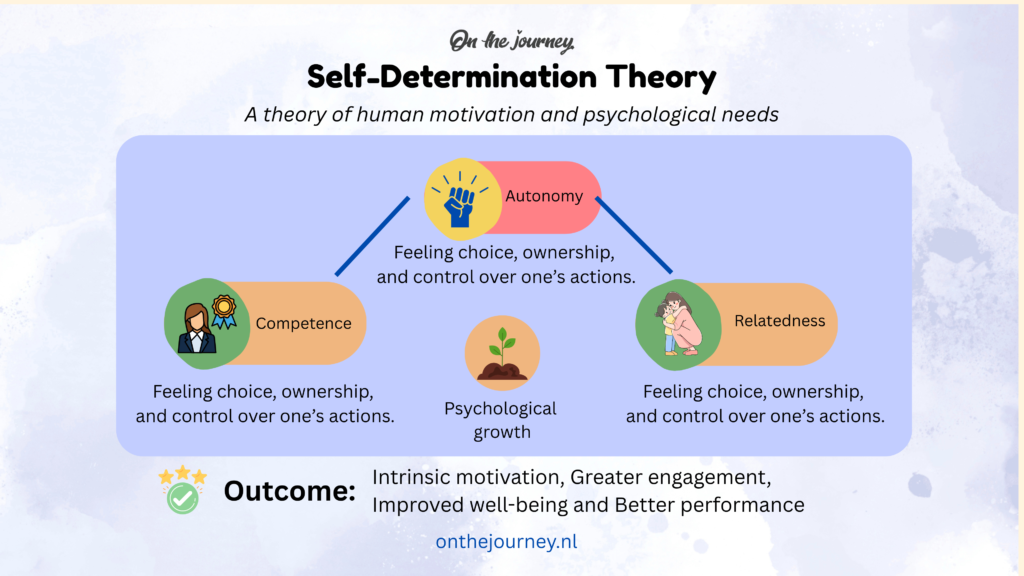
When these needs are supported, individuals are more likely to experience autonomous motivation and psychological well-being, whereas unmet basic psychological needs can lead to self-regulatory strain (Vansteenkiste et al., 2020). However, productivity may become psychologically costly when behaviour is primarily driven by internal pressure, guilt, or fear of inadequacy. Here is an article about psychological safety in the workplaces.
Within Self-Determination Theory, developed by psychologists Edward Deci and Richard Ryan (1985; Ryan & Deci, 2000), this resembles introjected regulation, a form of controlled motivation in which individuals act to avoid guilt or protect their self-esteem. For example, two employees may work equally hard but experience very different psychological motivations.
One employee works because they find their responsibilities meaningful and personally rewarding. Another works because stopping would make them feel guilty, inadequate, or unsuccessful.
Although their behaviour may appear similar, the psychological processes behind it are different.
Being highly productive does not necessarily mean being autonomously motivated. Sometimes, achievement is driven by the fear of not achieving enough.
Why Rest Is Essential for Psychological Recovery
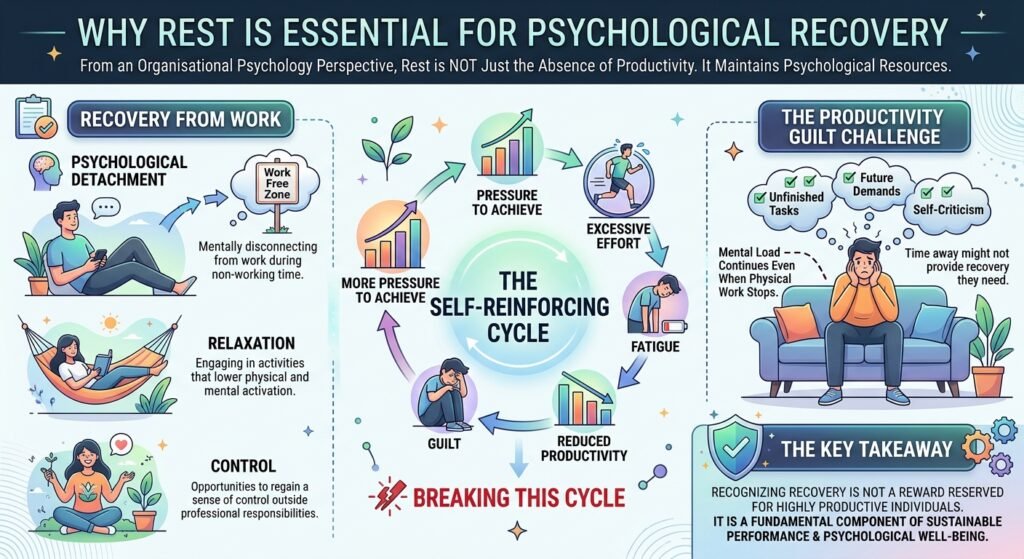
From an organisational psychology perspective, rest is not simply the absence of productivity but an essential process for maintaining and restoring psychological resources. Research on recovery from work emphasises the importance of psychological detachment, relaxation, and opportunities to regain a sense of control outside professional responsibilities.
Psychological detachment refers to mentally disconnecting from work during non-working time. However, individuals experiencing productivity guilt may find this particularly challenging.
Psychological detachment refers to mentally disconnecting from work during non-working hours, which can be particularly challenging for individuals experiencing productivity guilt. Even when physically away from work, they may continue reflecting on unfinished responsibilities, anticipating future demands, or criticising themselves for not accomplishing more.
As a result, time away from work may not provide the psychological recovery they need.
This can create a self-reinforcing cycle in which pressure to achieve leads to excessive effort, resulting in fatigue, reduced productivity, and feelings of guilt that further intensify the pressure to perform. Breaking this cycle requires recognising that recovery is not a reward reserved for highly productive individuals but a fundamental component of sustainable performance and psychological well-being.
The role of organisations to maintain sustainable work performance
A psychologically healthy workplace should distinguish between sustainable performance and constant activity. Being constantly busy does not necessarily mean being productive or effective. Employees need opportunities to rest and recover to maintain long-term performance. Organisations should value meaningful contributions rather than constant availability and visible busyness.
Organisations can help by:
- Evaluating outcomes rather than visible busyness. Working longer hours does not automatically mean producing better results.
- Encouraging healthy boundaries. Employees should not feel obligated to demonstrate commitment through constant availability.
- Normalising recovery. Breaks, holidays, and time away from work should be recognised as legitimate aspects of working life.
- Providing psychologically safe leadership. Managers should avoid creating environments where employees fear negative judgments for setting reasonable limits.
- Supporting realistic expectations. Clear priorities and manageable workloads can reduce the pressure to accomplish everything simultaneously.
Importantly, productivity guilt should not automatically be treated as an individual problem. Sometimes, the underlying issue is an organisational culture that equates personal dedication with uninterrupted performance.
How Can We Develop a Healthier Relationship With Productivity?
At an individual level, developing a healthier relationship with productivity begins with examining the beliefs that connect achievement to personal value.
Consider asking yourself:
- Do I work because this activity is meaningful to me, or because I feel guilty when I stop?
- Am I evaluating my day based only on what I accomplished?
- Do I allow myself to rest without first proving that I deserve it?
- Would I judge a colleague as harshly as I judge myself for taking a break?
These questions encourage reflection on the difference between healthy ambition and unhealthy productivity pressure. While healthy ambition supports meaningful goals and personal well-being, excessive pressure can turn every moment into self-evaluation. The goal is not to abandon achievement, but to develop a healthier relationship with productivity, where self-worth is not defined by accomplishments.
Conclusion: Your Worth Is Not Measured by Your Productivity
The most important thing is to acknowledge that we are human beings before we are productive employees. While productivity can contribute to feelings of competence, purpose, and professional fulfilment, problems arise when achievement becomes the primary measure of personal worth.
“A healthy relationship with work is not defined by how much we achieve, but by whether we can pursue achievement without sacrificing our psychological well-being.”
From an organisational psychology perspective, sustainable performance depends not only on what employees accomplish but also on the psychological conditions in which they work. Productivity guilt is deeply rooted in psychological and societal pressures that associate self-worth with constant achievement. However, it is important to recognise that constant busyness does not necessarily translate into meaningful personal or societal contributions.
Achieving sustainable performance requires developing a healthier relationship with productivity. This involves recognising that rest is not a reward that must be earned, but a fundamental psychological and biological necessity. Furthermore, breaking the cycle of productivity guilt requires separating personal self-worth from professional achievements and creating organisational environments that value meaningful contributions rather than constant activity. Ultimately, both individuals and organisations benefit from recognising that psychological well-being and sustainable performance are interconnected.
References
References
Deci, E. L., & Ryan, R. M. (1985). Intrinsic motivation and self-determination in human behavior. Plenum. DOI
Kernis, M. H. (2003). Toward a conceptualization of optimal self-esteem. Psychological Inquiry, 14(1), 1–26. https://doi.org/10.1207/S15327965PLI1401_01
Ryan, R. M., & Deci, E. L. (2000). Self-determination theory and the facilitation of intrinsic motivation, social development, and well-being. American Psychologist, 55(1), 68–78. https://doi.org/10.1037/0003-066X.55.1.68
Vansteenkiste, M., Ryan, R. M., & Soenens, B. (2020). Basic psychological need theory: Advancements, critical themes, and future directions. Motivation and Emotion, 44(1), 1–31. https://doi.org/10.1007/s11031-019-09818-1