

Mert is an expat from Turkey who has been living in the Netherlands for a year. He frequently experiences health anxiety. Whenever he notices an unfamiliar sensation or symptom in his body, he becomes extremely worried. He tries to diagnose himself, searches for symptoms online and struggles to focus on anything else. On these days, everyday life can become very difficult.
While living in Turkey, Mert regularly attended medical check-ups and could often arrange tests or consultations with specialists relatively quickly. After moving to the Netherlands, he encountered a different healthcare system. He usually had to contact his huisarts, or general practitioner, first. Depending on the symptoms, the GP might recommend monitoring the situation, trying an initial treatment or waiting before arranging further tests or a specialist referral.
The Dutch system aims to provide appropriate, evidence-based care and avoid investigations or treatments that are unlikely to benefit the patient. However, Mert sometimes experiences this approach as difficult or emotionally distressing. Waiting and not immediately receiving a test can make him fear that an illness is being overlooked. The difference between his expectations and the Dutch approach can therefore intensify his health anxiety and make it harder for him to feel safe.
Many expats experience similar difficulties. In the Netherlands, healthcare usually begins with the huisarts, who assesses the symptoms and decides whether further testing, treatment or specialist care is needed. Although this approach can be efficient, it may feel dismissive or unsafe to someone who is already struggling with uncertainty about their health.
Understanding both health anxiety and the role of the huisarts can help expats communicate their concerns more effectively, access appropriate psychological support and gradually regain a sense of control.
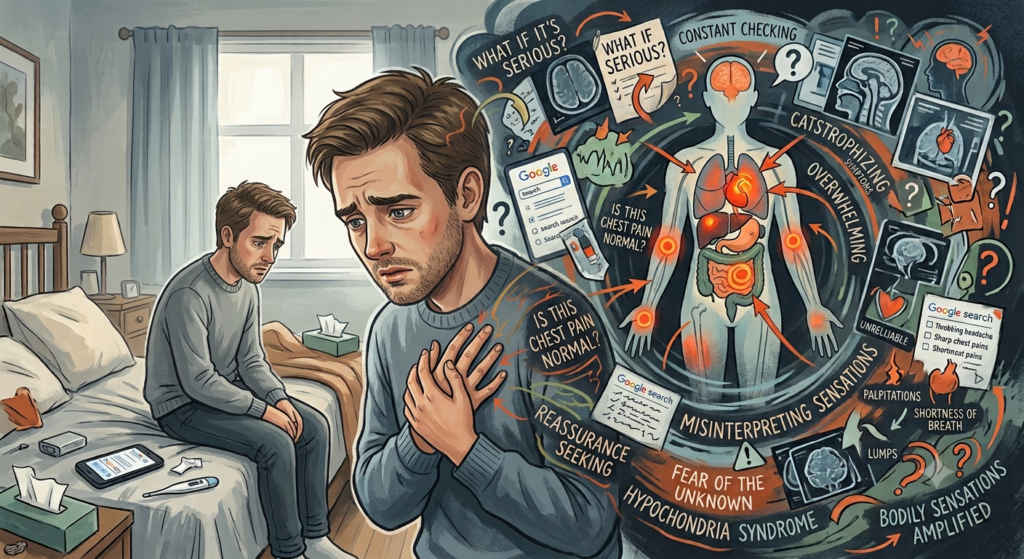
What Is Health Anxiety?
Health anxiety is a persistent and excessive fear of having or developing a serious illness. A person may interpret common or harmless bodily sensations such as a headache, tiredness, a rapid heartbeat, chest tightness or shortness of breath which are signs of a dangerous medical condition. Any form of anxiety has a strong link with how thoughts are formulated, here is a blog article in On The Journey about how thoughts are formed.
People experiencing health anxiety may:
- Monitor their bodies repeatedly;
- Search for symptoms online;
- Ask friends, relatives or professionals for reassurance;
- Repeatedly contact healthcare providers;
- Request medical examinations or tests;
- Avoid doctors because they fear receiving bad news;
- Avoid activities they believe might harm their health.
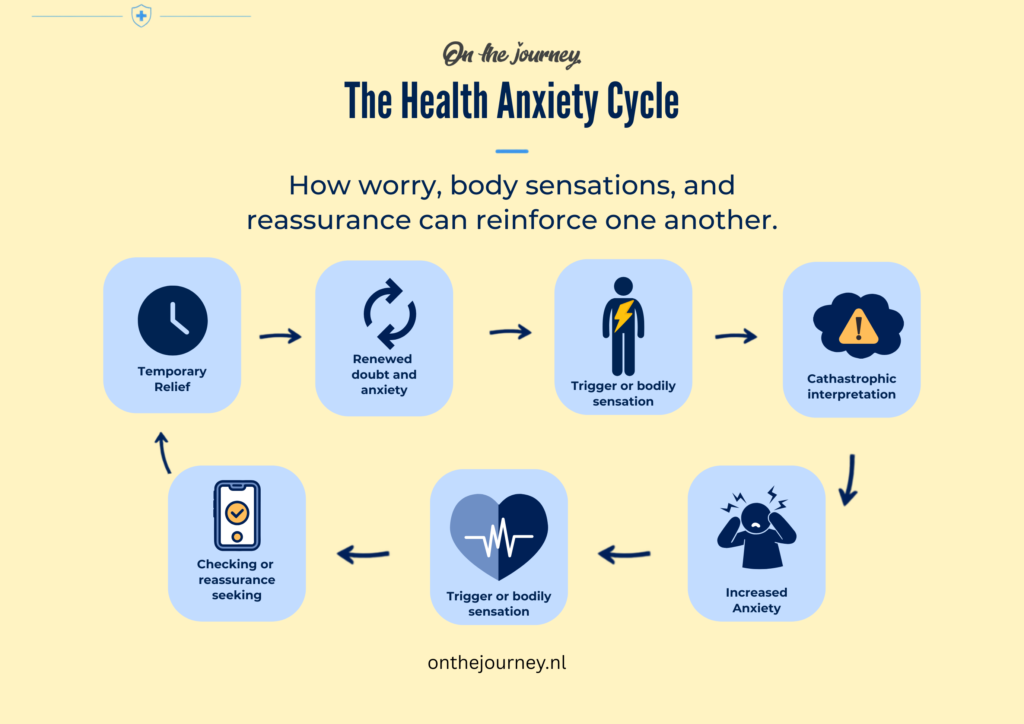
These behaviours are usually attempts to feel safer. However, the relief they provide often lasts only briefly. Doubt then returns, leading to further checking and reassurance-seeking.
Health anxiety was historically called hypochondria. In the DSM 5 TR, illness anxiety disorder is classified under Somatic Symptom and Related Disorders. A person with illness anxiety disorder is preoccupied with having or developing a serious illness, usually has few or no significant physical symptoms, and remains highly anxious despite medical reassurance. This preoccupation is persistent, typically lasting at least six months, and may involve excessive health related behaviours or avoidance of medical care.
- Monitor their bodies repeatedly;
- Search for symptoms online;
- Ask friends, relatives or professionals for reassurance;
- Repeatedly contact healthcare providers;
- Request medical examinations or tests;
- Avoid doctors because they fear receiving bad news; or
- Avoid activities they believe might harm their health.
These behaviours are usually attempts to feel safer. However, the relief they provide often lasts only briefly. Doubt then returns, leading to further checking and reassurance-seeking.
However, not everyone who worries about their health has illness anxiety disorder. A diagnosis requires a careful assessment by a qualified healthcare professional. Physical symptoms should not automatically be dismissed as psychological, and new, severe or worsening symptoms should still be medically evaluated.
Health Anxiety and the Dutch Healthcare System
People like Mert may be accustomed to arranging specialist appointments and medical tests more directly in their home country. In the Netherlands, patients generally contact their GP first. The GP assesses the problem, provides advice or treatment and determines whether further examination or referral is medically appropriate. Here you can find more information about the Dutch Healthcare System.
When Mert cannot obtain a scan, blood test or specialist appointment as quickly as he expects, he may begin searching for symptoms online or repeatedly contacting the GP practice. The difficulty is therefore not only the healthcare procedure itself. Uncertainty, waiting and limited access to immediate testing can activate and intensify his existing health anxiety.
At the same time, repeated medical tests do not necessarily resolve health anxiety. A normal result may provide temporary relief, but a new symptom or doubt can soon appear. The person may then feel compelled to seek another test. Treatment therefore needs to address both appropriate medical care and the anxiety cycle surrounding bodily sensations.
How Does a Health-Anxiety Episode Develop?
A health-anxiety episode may begin suddenly with a bodily sensation, an intrusive thought or a medical story.
For example, a person may notice a small lump in their neck and immediately think:
What if this is cancer?
That interpretation increases anxiety. Anxiety can then produce or intensify physical sensations, including:
- dizziness;
- muscle tension;
- nausea;
- sweating;
- chest tightness;
- changes in breathing;
- tiredness; and
- a faster or more noticeable heartbeat.
The person becomes increasingly focused on their body and may interpret these anxiety-related sensations as further evidence of illness. This strengthens the original fear.
The cycle can be represented as follows:
A health-anxiety episode may also be triggered by reading a medical article, hearing about someone’s diagnosis or watching a story involving illness. The feared possibility can seem to take over the person’s attention, making it difficult to consider more ordinary explanations.
The Vicious Loop of Googling Symptoms
The urge to search the internet often begins with a desire for reassurance. A person hopes to discover that the symptom is harmless and quickly feel calmer.
However, online searches can easily become a vicious loop. Search results often display long lists of possible conditions, including rare and serious illnesses. The person may focus on the most frightening explanation rather than the most probable one.
This increases anxiety and may cause sensations such as nausea, sweating, muscle tension or a racing heartbeat. Those sensations may then be interpreted as additional evidence that something is wrong.
The person searches again, compares more symptoms and becomes increasingly uncertain. Even when reassuring information is found, relief may last for only a short time.
Reducing symptom searches can initially feel uncomfortable because it requires tolerating uncertainty. However, learning to delay or limit searches is often an important step in breaking the cycle.
Treatment options for health anxiety
Cognitive Behavioral Therapy
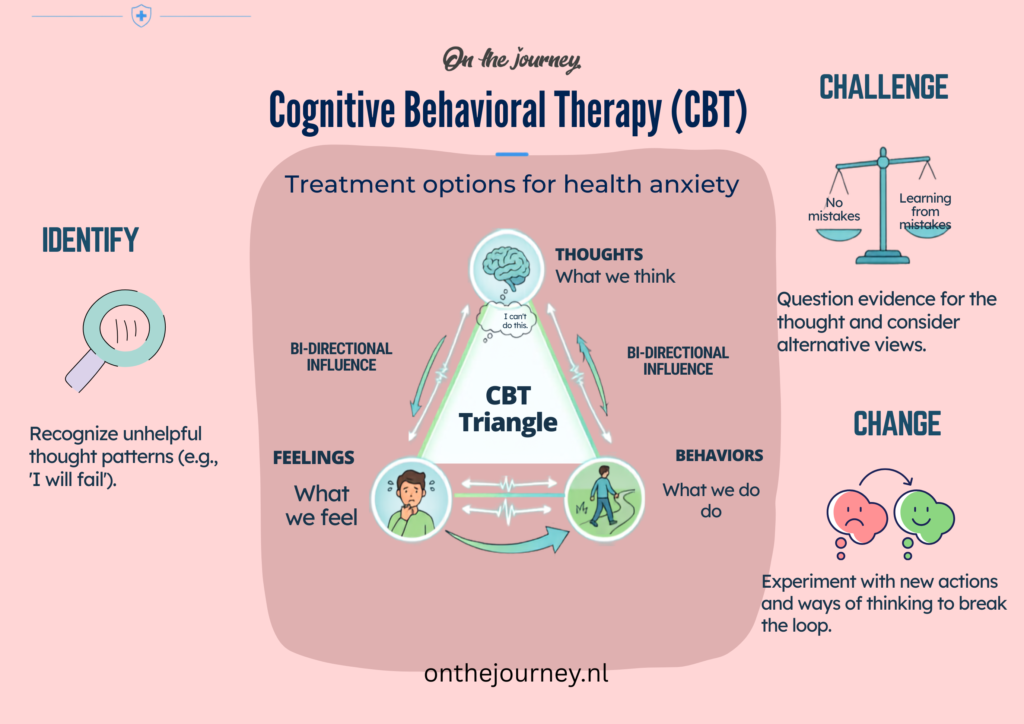
Cognitive behavioural therapy, or CBT, is an established psychological treatment for health anxiety. It helps people understand how thoughts, emotions, bodily sensations and behaviours reinforce one another.
- identify catastrophic interpretations of bodily sensations;
- examine the evidence for and against feared conclusions;
- consider more balanced explanations;
- reduce repeated body-checking;
- reduce symptom searches and reassurance-seeking;
- tolerate uncertainty;
- approach activities or situations they have been avoiding; and
- respond differently to frightening health-related thoughts.
Behavioural experiments may be used to test anxious predictions. For example, someone might postpone checking a bodily sensation and observe whether the feared outcome actually occurs. Treatment may also include diaries, worksheets, planned exercises and practice between sessions.
The goal is not to convince someone that they will never become ill. No one can receive that guarantee. Instead, treatment helps the person develop a more flexible relationship with uncertainty, bodily sensations and health-related thoughts.
Medication
Medication may sometimes be considered, particularly when health anxiety occurs alongside depression, obsessive-compulsive disorder or another anxiety disorder.
Selective serotonin reuptake inhibitors, or SSRIs, are commonly used for several anxiety-related conditions. They reduce the reuptake of serotonin between nerve cells, changing serotonin signalling. Their therapeutic effects usually develop gradually as the brain adapts over several weeks.
Medication does not provide instant reassurance and is not suitable for everyone. Possible benefits, side effects, interactions and discontinuation plans should be discussed with a GP, psychiatrist or other qualified prescriber. Medication should not be started, reduced or stopped without professional guidance.
If you want to learn more about the topic, here is an article explaining about anxiety disorder and its influence on mental health.
Managing Health Anxiety in the Nethlerlands
Health worries may feel more intense when living abroad. An expat may be unfamiliar with the healthcare system, uncertain about what is considered urgent or find it difficult to explain symptoms in another language.
You may also feel frustrated when your Dutch GP does not immediately arrange scans, blood tests or specialist appointments. For someone experiencing health anxiety, this can create a powerful fear that a serious illness is being overlooked. Here are some approaches that could help with managing health anxiety.
Tell your GP about health anxiety
Do not discuss only the physical symptom. Explain how much time you spend worrying, checking, searching online or seeking reassurance.
You might say:
“I understand that this symptom may not require immediate testing, but I am experiencing intense health anxiety. I repeatedly check my body and search online, and it is affecting my daily life. Can we discuss support for the anxiety as well as the physical symptom?”
This helps the GP understand the complete situation.
Ask for a clearer plan
Uncertainty can become more manageable when you understand what will happen next. Consider asking:
- What is the most likely explanation?
- Which warning signs should I look out for?
- How long should I monitor the symptom?
- When should I contact the practice again?
- Under what circumstances would further tests or a referral become appropriate?
Ask for psychological support
Your GP may provide initial guidance or refer you to a praktijkondersteuner huisarts geestelijke gezondheidszorg, often called a POH GGZ, a psychologist, or a specialised mental health service, depending on the severity and complexity of the problem.
A referral for psychological support does not mean that your physical concerns are being dismissed. It means that the emotional distress, checking behaviors and persistent fear also deserve treatment.
Reduce Symptom Searching
Try to avoid repeatedly googling symptoms. Searching can direct your attention toward rare and frightening explanations and make bodily sensations feel more threatening.
When you feel the urge to search, write down:
- what you noticed;
- what you fear it means;
- how anxious you feel;
- what you want the search to give you; and
- what might happen if you wait before searching.
Begin by postponing the search for a limited period rather than demanding that you stop completely. The aim is to learn that anxiety can rise and fall without immediate checking.
Educate Yourself About Mental Health
Overcoming Health Anxiety by David Veale and Rob Willson is a practical self-help book based on cognitive behavioural therapy.
The book explains how health anxiety develops and how behaviours such as checking the body, searching for symptoms online, seeking reassurance and repeatedly consulting doctors can keep the fear going. It includes questionnaires, case examples and structured exercises designed to help readers examine anxious interpretations, reduce unhelpful habits and manage fears surrounding illness, death and vomiting.
A self-help book may support recovery, but it does not replace an individual medical or psychological assessment. People whose anxiety is persistent, highly distressing or disruptive to everyday life should discuss it with their GP or a qualified mental-health professional.
Conclusion
Navigating a new healthcare system can be challenging for anyone, especially for expats like Mert who are also struggling with health anxiety. The Dutch healthcare system is structured, evidence-based and GP-led. However, the natural urge to seek immediate tests and reassurance may conflict with an approach that often involves monitoring symptoms, waiting for referrals and allowing time before further examinations are arranged. Compared with Turkey, where specialist appointments and test results may sometimes be available within a day or two, this process can feel slow and emotionally difficult.
It is important to recognise that although reassurance may feel helpful in the moment, it rarely provides lasting relief. Instead, it can reinforce a cycle in which anxiety intensifies physical sensations, leading to more checking, online searching and worry. Information found online may also be misleading or overly alarming, which can further increase anxiety and negatively affect mental well-being over time. Breaking this cycle requires attention not only to physical concerns, but also to the thoughts and behaviours that maintain health anxiety.
Understanding the role of the huisarts is an important first step towards communicating effectively within the Dutch healthcare system. By speaking openly with your GP not only about physical symptoms, but also about the intensity and impact of your anxiety, you may be able to access appropriate support. This can include Cognitive Behavioural Therapy, medication, support from the POH-GGZ or structured self-help strategies.
Ultimately, managing health anxiety does not mean ignoring physical symptoms or assuming that nothing is wrong. It means learning to respond to bodily sensations in a more balanced way, tolerate uncertainty and seek medical help appropriately. With the right support, expats can gradually regain a sense of control and feel safer and more confident while living in the Netherlands.
References
American Psychiatric Association. (2022). Diagnostic and statistical manual of mental disorders (5th ed., text rev.; DSM-5-TR). American Psychiatric Publishing.
Asmundson, G. J. G., & Taylor, S. (2002). It’s not all in your head: How worrying about your health makes you sick—and what you can do about it. Guilford Press.
National Institute for Health and Care Excellence. (2011). Generalised anxiety disorder and panic disorder in adults: Management (NICE Guideline CG113). https://www.nice.org.uk/guidance/cg113
Starcevic, V., & Berle, D. (2013). Cyberchondria: Towards a better understanding of excessive health-related Internet use. Expert Review of Neurotherapeutics, 13(2), 205–213. https://doi.org/10.1586/ern.12.162
van Avendonk, M. J. P., Hassink-Franke, L. J. A., Terluin, B., van Marwijk, H. W. J., Wiersma, T., & Burgers, J. S. (2012). Summarisation of the NHG practice guideline ‘Anxiety’. Nederlands Tijdschrift voor Geneeskunde, 156(34), A4509.
Veale, D., & Willson, R. (2009). Overcoming health anxiety: A self-help guide using cognitive behavioural techniques. Robinson.