
Industrial and Organisational (I/O) Psychology seeks to answer fundamental questions about human behaviour at work: Why do some employees thrive while others struggle despite having similar qualifications and abilities? Why do some leaders inspire motivation and confidence, while others create anxiety and disengagement?
Industrial and Organisational Psychology (I/O Psychology) has sought to answer these questions for more than a century. The field began in the early twentieth century with a narrow focus on industrial efficiency, task standardisation, and maximising physical output. As workplaces evolved from factory floors and post-war assessment centres to today’s hybrid and AI-driven environments, decades of research broadened the field into a comprehensive science of human behaviour at work. Its scope now includes motivation, leadership, organisational culture, psychological safety, and inclusion.
“What a man can be, he must be. This need we may call self-actualization.” — Abraham Maslow
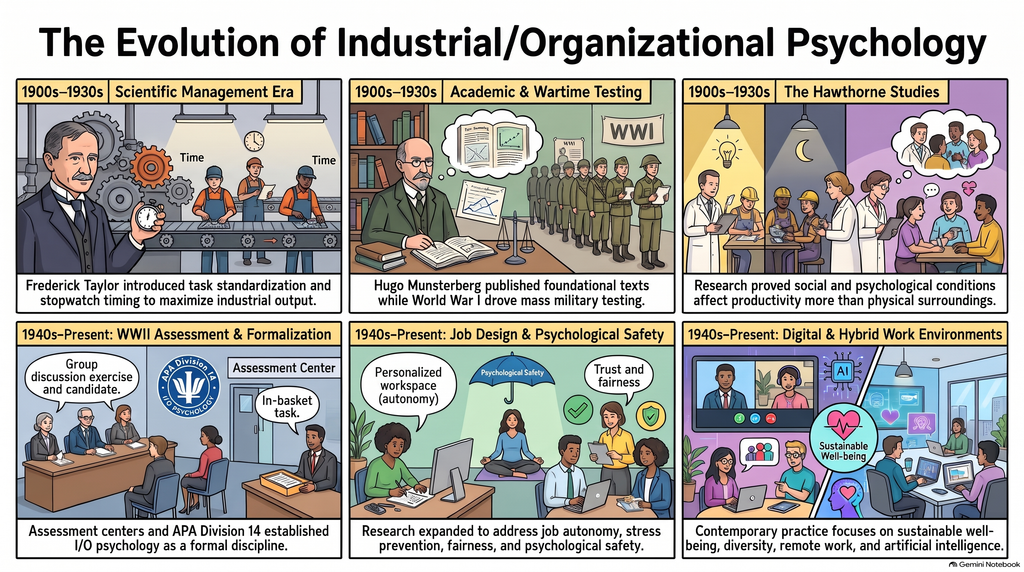
This timeline traces the key milestones in the evolution of I/O Psychology, illustrating how the discipline moved from viewing workers primarily as instruments of productivity to recognising employee well-being and human flourishing as essential foundations for sustainable organisational success.
The 1910s–1920s: The Emergence of Industrial Psychology
Industrial and Organisational (I/O) Psychology began to take shape through the contributions of Hugo Münsterberg, Walter Dill Scott, and Walter Van Dyke Bingham, who introduced psychological principles into employee selection, assessment, and performance. The First World War accelerated the development and application of psychological testing, laying the foundations for modern recruitment, personnel assessment, and person–job fit.
How can we match the right person with the right job?
The 1920s–1930s: The Human Relations Movement
Industrial and Organisational (I/O) Psychology experienced a significant shift through the Hawthorne Studies (1924–1932), which contributed to recognising the importance of social relationships, group dynamics, and supervision in shaping employee behaviour and performance. Workplaces increasingly came to be understood as complex social environments rather than purely production systems, highlighting the importance of human and psychological factors at work.
How do social relationships influence employee performance?
The 1940s: The Formalisation of Industrial Psychology
Industrial and Organisational (I/O) Psychology became increasingly established during and after the Second World War, which accelerated developments in psychological assessment, employee selection, and training. The establishment of Division 14 within the American Psychological Association (APA) in 1945 marked an important milestone in the formal recognition of Industrial Psychology as a scientific discipline, strengthening its role in understanding and improving human performance in organisational environments.
How can psychological science improve organisational effectiveness?
The 1950s–1970s: Human Motivation and Psychological Needs
Maslow, Herzberg, McGregor, Vroom, and Hackman and Oldham expanded our understanding of employee motivation. Recognition, autonomy, achievement, meaningful work, and personal development gained increasing importance.
What makes employees genuinely motivated at work?
The 1970s–1990s: Organisational Culture and Leadership
Industrial and Organisational Psychology (I/O) further expanded through Edgar Schein’s research on organisational culture and the development of transformational leadership theories, highlighting how shared values, trust, leadership, and organisational environments shape employee behaviour, motivation, and engagement.
How do leadership and organisational culture shape employee experiences?
The 1970s–2000s: Occupational Stress and Burnout
Karasek’s Job Demand–Control Model, Maslach’s burnout research, and the Job Demands–Resources Model highlighted how workload, limited autonomy, and insufficient support affect psychological health.
Employee well-being increasingly became an organisational responsibility.
How can organisations achieve high performance without compromising psychological health?
The 1980s and Beyond: Self-Determination Theory
Edward Deci and Richard Ryan’s Self-Determination Theory identified three basic psychological needs: autonomy, competence, and relatedness. Their research emphasised the importance of supporting autonomous motivation rather than relying on external pressure.
Are employees motivated by genuine interest or pressure to perform?
The 1990s–2000s: Positive Psychology and Work Engagement
William Kahn and Wilmar Schaufeli contributed to understanding positive psychological experiences at work. Attention increasingly shifted towards engagement, meaningful work, vigour, dedication, and personal strengths.
How can organisations help employees thrive rather than simply survive?
The 1990s and Beyond: Psychological Safety
Amy Edmondson’s research on psychological safety highlighted the importance of creating environments where employees can ask questions, acknowledge mistakes, and express concerns without fear of humiliation or punishment. Here is an article about psychological safety.
Can employees express themselves freely without fear of negative consequences?
The 2000s and Beyond: Diversity, Inclusion and Belonging
Industrial and Organisational Psychology (I/O) increasingly examined how cultural differences and unconscious bias shape employees’ experiences of fairness, professional identity, and belonging as globalisation transformed workplaces. Within the field, inclusion came to mean having meaningful opportunities to contribute and feeling respected for one’s individual differences.
Can employees genuinely belong without compromising their identity?
The 2020s and Beyond: Hybrid Work, Digitalisation and Artificial Intelligence
Industrial and Organisational Psychology (I/O) examines how hybrid work and new technologies can give employees greater flexibility and autonomy and help them work more efficiently, while also contributing to digital overload, social isolation, job insecurity, and blurred work–life boundaries.
How can organisations embrace technological progress without compromising human well-being?
The Future: Psychologically Sustainable Work
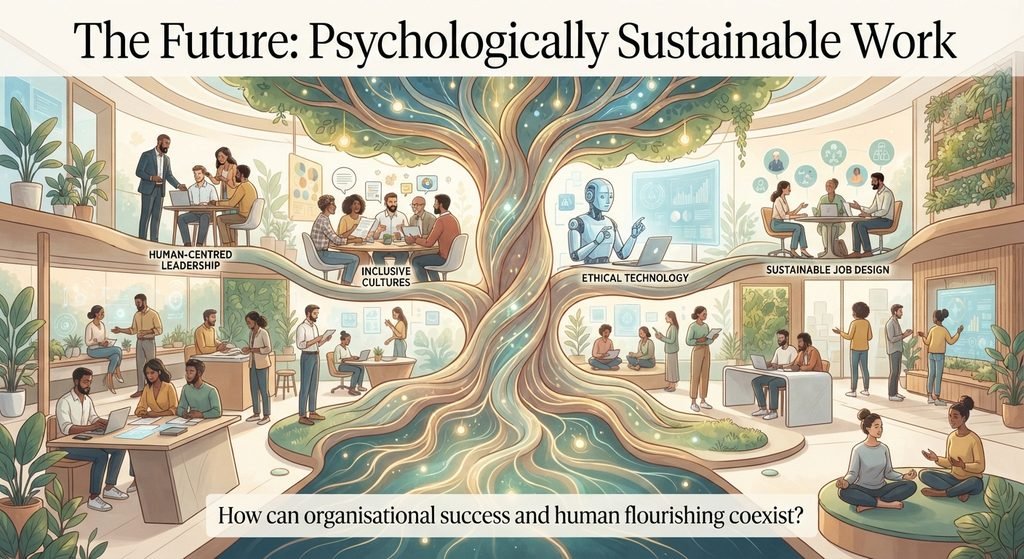
The future of organisational psychology lies in integrating organisational effectiveness with psychological sustainability through human-centred leadership, inclusive cultures, ethical technology, and sustainable job design.
How can organisational success and human flourishing coexist?
Conclusion: From Industrial Efficiency to Human Flourishing
The evolution of Industrial and Organisational Psychology (I/O) reflects a fundamental shift from viewing employees as instruments of productivity towards recognising them as individuals with psychological needs, aspirations, and potential for growth.
Sustainable organisational performance cannot be separated from employee well-being.
The future of work should not be defined solely by what organisations can achieve through people, but also by what people can become through their experiences within organisations.
Conclusion: From Industrial Efficiency to Human Flourishing
The evolution of Industrial and Organisational Psychology (I/O) reflects a fundamental shift from viewing employees as instruments of productivity towards recognising them as individuals with psychological needs, aspirations, and potential for growth.
Sustainable organisational performance cannot be separated from employee well-being.
The future of work should not be defined solely by what organisations can achieve through people, but also by what people can become through their experiences within organisations.
A Question for Reflection
After more than a century of progress in organisational psychology, have workplaces genuinely become more human-centred, or have we simply developed more sophisticated methods of managing human performance?
Note: These historical periods overlap and represent selected milestones rather than an exhaustive historical account.
References
Demerouti, E., Bakker, A. B., Nachreiner, F., & Schaufeli, W. B. (2001). The job demands-resources model of burnout. Journal of Applied Psychology, 86(3), 499–512. https://doi.org/10.1037/0021-9010.86.3.499 Cited by: 27818
Edmondson, A. (1999). Psychological safety and learning behavior in work teams. Administrative Science Quarterly, 44(2), 350–383. https://doi.org/10.2307/2666999 Cited by: 26127
Karasek, R. A. (1979). Job demands, job decision latitude, and mental strain: Implications for job redesign. Administrative Science Quarterly, 24(2), 285–308. https://doi.org/10.2307/2392498 Cited by: 24679
Maslach, C., & Jackson, S. E. (1981). The measurement of experienced burnout. Journal of Organizational Behavior, 2(2), 99–113. https://doi.org/10.1002/job.4030020205 Cited by: 33369
Maslow, A. H. (1943). A theory of human motivation. Psychological Review, 50(4), 370–396. https://doi.org/10.1037/h0054346 Cited by: 75605
Mayo, E. (2004). The human problems of an industrial civilization. Routledge. (Original work published 1933). https://doi.org/10.4324/9780203487273 Cited by: 10173
McGregor, D. M. (1985). The human side of enterprise. In Readings and exercises in organizational behavior (pp. 28–35). Elsevier. (Original work published 1960). https://doi.org/10.1016/b978-0-12-054752-4.50008-7 Cited by: 28053
Ryan, R. M., & Deci, E. L. (2000). Self-determination theory and the facilitation of intrinsic motivation, social development, and well-being. American Psychologist, 55(1), 68–78. https://doi.org/10.1037/0003-066x.55.1.68 Cited by: 97964