

What defines a psychologically unhealthy workplace? Overwhelming workloads? Unrealistic deadlines? Sometimes, it begins with a leader who displays narcissistic behavioural patterns that gradually change how employees perceive themselves. The messages we repeatedly receive can shape our identity, particularly when they come from figures of authority. In workplaces where narcissistic leadership allows criticism to replace encouragement, control to replace autonomy, and fear to replace psychological safety, employees may begin to lose not only their motivation but also their sense of professional identity.
Anna, a 35-year-old marketing professional from Poland, moved to the Netherlands with eight years of experience. Despite her qualifications, she struggled to adapt to a workplace culture that encouraged spontaneous communication and open debate. Her manager interpreted her reflective communication style as a lack of confidence and engagement, despite her strong performance. Over time, Anna began doubting her abilities, working longer hours, and feeling increasingly isolated. What appeared to be a performance issue was actually a mismatch between communication styles and workplace expectations, highlighting the importance of psychological safety, cultural awareness, and inclusive leadership.
Read more about the article, recovering from intense workplace.
There are many people like Anna who gradually develop a deep fear of the workplace as a result of unhealthy management practices. The first few months are often spent working excessively and trying to prove their skills and abilities. For individuals who struggle with self-confidence and seek approval, particularly from authority figures, their passion for work may gradually turn into something psychologically destructive. What once motivated them may eventually begin to consume them from within. This happens partly because their initial response to repeated criticism is often to internalise it.
Over time, this internalisation may give rise to an excessively critical inner voice, making employees increasingly vulnerable to criticism from both themselves and others. Eventually, the psychological pressure may become so overwhelming that they struggle to continue working. They become trapped in an endless cycle of overworking, self-criticism, and emotional exhaustion, which may ultimately lead to burnout. What began as a vulnerability related to self-confidence or a need for external validation can develop into serious psychological distress, potentially forcing individuals to take a break from work and seek professional mental health support to address the internalised patterns that have developed over time.
Traits of Narcissism
To understand the dynamics of relationships involving individuals with narcissistic traits and their potential impact on psychological well-being, it is essential to first examine the defining characteristics of narcissism.
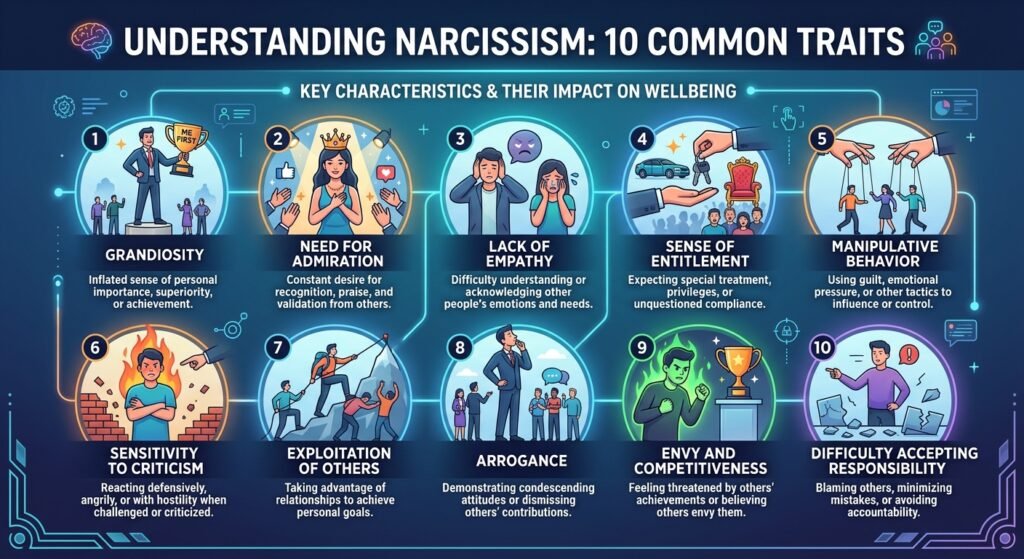
The most commonly associated narcissistic traits include:
- Grandiosity: An exaggerated sense of self-importance, superiority, or personal achievement.
- Need for admiration: A persistent desire for recognition, praise, and validation from others.
- Lack of empathy: Difficulty recognising, understanding, or acknowledging other people’s emotions, needs, and perspectives.
- Sense of entitlement: Expecting special treatment, privileges, or unquestioned compliance from others.
- Manipulative behaviour: Using guilt, emotional pressure, or other tactics to influence or control others.
- Sensitivity to criticism: Responding defensively, angrily, or with hostility when challenged or criticised.
- Exploitation of others: Taking advantage of other people or relationships to achieve personal goals.
- Arrogance: Displaying condescending attitudes or dismissing the opinions and contributions of others.
- Envy and competitiveness: Feeling threatened by other people’s achievements, envying others, or believing that others are envious of them.
- Difficulty accepting responsibility: Blaming others, minimising personal mistakes, or avoiding accountability for one’s actions.
Narcissistic Leadership Behavioral Patterns
Narcissistic leadership behaviours are characterised by excessive self-importance, low empathy, and interpersonal exploitation. These behaviours may undermine psychological safety and contribute to employee stress. Chronic exposure to such leadership practices can create psychological insecurity, fear, and uncertainty, causing employees to focus more on avoiding criticism than expressing creativity or finding satisfaction in their work.
Leaders who display narcissistic traits may demonstrate patterns of controlling, manipulative, and self-centred behaviour that gradually undermine employees’ psychological well-being. What may initially be perceived as merely irritating behaviour, such as a constant need for admiration or defensive and aggressive reactions when their authority is questioned, can become increasingly harmful over time. Such leaders may also engage in excessive micromanagement, show favouritism, shift blame onto employees, and set unrealistic expectations while offering little recognition or support.
Communicating with leaders who exhibit narcissistic traits can be emotionally exhausting, as employees may constantly feel the need to monitor their words, anticipate negative reactions, and carefully adjust their behaviour to avoid conflict. Even routine conversations can become psychologically demanding when leaders react defensively to feedback, dismiss concerns, or interpret disagreements as personal attacks. This constant state of vigilance consumes emotional and cognitive resources, leaving employees mentally drained and less able to focus on creativity, collaboration, and meaningful work.
Key Drivers of Work Performance and the Negative Influence of Narcissistic Management
Workplace performance is influenced by several factors, including motivation, skills, psychological safety, leadership quality, autonomy, role clarity, job resources, employee well-being, and organisational culture. When employees feel valued and supported, they are more likely to demonstrate engagement, creativity, and commitment. However, even highly skilled and motivated individuals may struggle in environments that fail to support their psychological and professional needs.
Narcissistic management behaviours can undermine psychological safety, autonomy, motivation, and employee confidence. Excessive criticism, a lack of recognition, and controlling behaviour may contribute to emotional exhaustion, reduced work engagement, and declining performance. Over time, employees may become more focused on avoiding criticism than expressing creativity or taking initiative. This highlights the important role of leadership and the psychological work environment in shaping employee performance.
From Passion to Constant Approval-Seeking
Initially, employees may feel enthusiastic about demonstrating their abilities and earning recognition for their work. However, when working under a leader who is excessively demanding, dismisses their achievements, and provides unpredictable feedback, their motivation may gradually begin to shift.
Over time, work can become increasingly stressful as employees focus more on avoiding criticism and gaining approval in an attempt to prove their worth. Psychologically, work may shift from being a source of enjoyment and fulfilment to becoming a constant effort to avoid criticism, seek validation, and demonstrate self-worth. This can be particularly harmful for individuals who already struggle with low self-confidence, perfectionism, or a strong need for external validation.
Their motivation gradually shifts from “I love what I do” to “I need to prove that I am good enough.”
When External Criticism Becomes an Internal Voice
Repeated exposure to criticism at a younger age can be particularly damaging to psychological well-being, as individuals may gradually internalise negative feedback. Younger employees may be more dependent on guidance and approval from senior figures, making them potentially more vulnerable to criticism while developing their professional identity and confidence.
Prolonged exposure to criticism from authority figures may lead employees to question their abilities, interpret minor mistakes as personal failures, and develop excessively high expectations of themselves. Even when the leader is physically absent, employees may continue to mentally evaluate their performance, anticipate criticism, and worry about potential mistakes, creating a persistent cycle of self-doubt, anxiety, and overthinking.
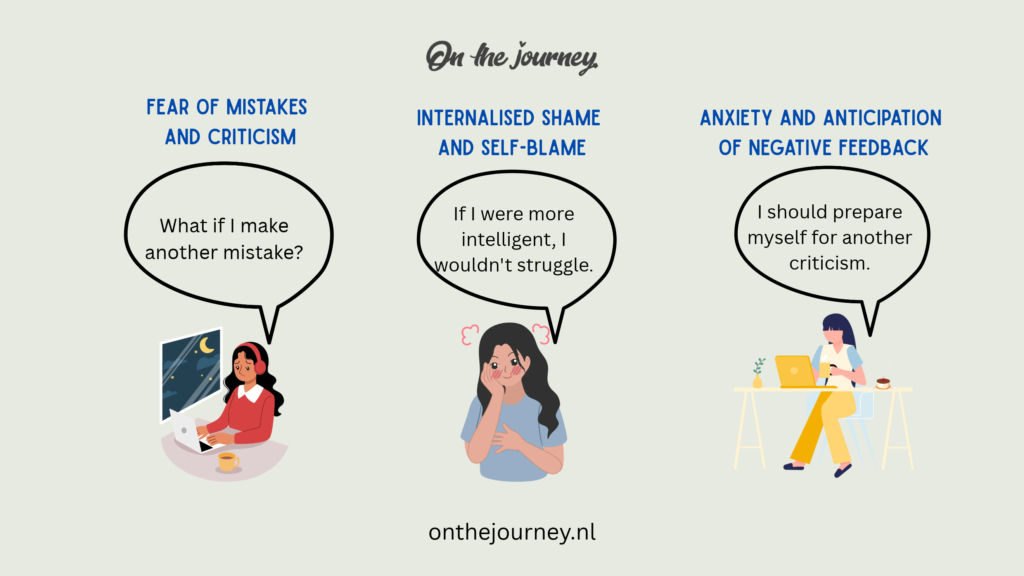
Over time, the leader’s critical voice may become internalised and gradually form part of the employee’s own inner dialogue. What initially began as external criticism may evolve into a harsh internal judgement system, through which individuals continuously evaluate themselves using the same critical standards they have repeatedly experienced. This creates a destructive psychological cycle in which external pressure is reinforced by internal self-criticism.
Even in the absence of external criticism, this internalised critical voice may continue to influence how employees perceive their abilities and performance. Persistent self-doubt, unrealistic expectations, and fear of making mistakes can contribute to emotional exhaustion and increase the risk of burnout.
Conclusion
Unhealthy leadership can gradually transform professional passion into self-doubt, fear of failure, and emotional exhaustion. When repeated criticism becomes internalised, employees may continue to question their abilities even in the leader’s absence. Over time, this cycle can undermine their confidence, motivation, and sense of professional identity, potentially contributing to burnout.
Healthy leadership should foster confidence rather than insecurity, encourage growth rather than fear, and create an environment where employees feel valued without constantly having to prove their worth. Ultimately, psychological well-being is not separate from workplace performance; it is an essential foundation for sustainable motivation, work engagement, and professional growth.
References
Asrar-ul-Haq, M., & Anjum, T. (2020). Impact of narcissistic leadership on employee work outcomes in banking sector. Future Business Journal, 6, 34.
Nevicka, B., De Hoogh, A. H. B., Den Hartog, D. N., & Frijns, J. H. M. (2018). Narcissistic leaders and their victims: Followers low on self-esteem and low on core self-evaluations suffer most. Frontiers in Psychology, 9, 422. https://doi.org/10.3389/fpsyg.2018.00422
Chatterjee, A., & Hambrick, D. C. (2007). It’s all about me: Narcissistic chief executive officers and their effects on company strategy and performance. Administrative Science Quarterly, 52(3), 351–386. https://doi.org/10.2189/asq.52.3.351