
Have you ever felt your mind got completely stuck on a single stressful thought? It usually starts with something small going wrong. It might be a sharp comment from someone or the sudden realization that a huge deadline is looming. Suddenly, overthinking occurs and your brain starts spinning in a fast, repetitive circle.
Overthinking feels exactly like a scratched record that keeps playing the same two seconds of a song over and over again. You keep replaying that one worry in your head at high speed, but you never actually find a solution or reach to the end of the “song.” You’re just trapped in a loop, unable to find any peace or move on to the next thought.

Those looping thoughts while overthinking can feel like they are a cage you can’t escape, making you worry that something is fundamentally wrong with you? It is important to know that having a mind that spins in circles doesn’t mean you are broken. This is not a faulty action or a mistake. On the contrary it is a survival mechanism that your brain uses to try keeping you safe to a fast moving mind like a high-powered racing engine. The goal is to acknowledge how the machine operates and start steering that power in a direction that you want to go.
The Innovation Spectrum
You aren’t just ‘thinking too much’; you are operating with the high-octane Need for Cognition typically reserved for world-class innovators. Research by Dr. Alice Boyes suggests that your tendency to ruminate is actually a high-performance engine running in neutral. While most people default to mental shortcuts to save energy, you possess rare cognitive stamina. You lean into complex mental labor, revisiting unresolved ideas like a jigsaw puzzle that others would have abandoned long ago.
To shift this trait from a source of misery to a driver of greatness, you must master two specific “hidden gems”:
Knowledge Transfer: Instead of looping on personal “what-ifs,” redirect your pattern-matching brain to connect insights across different domains turning a past mistake in one area into a breakthrough solution in another.
Cognitive Closure: Rather than panicking because a “puzzle” is unfinished, learn to tolerate the discomfort of the unknown. This allows you to wait for the best answer rather than settling for the fastest one.
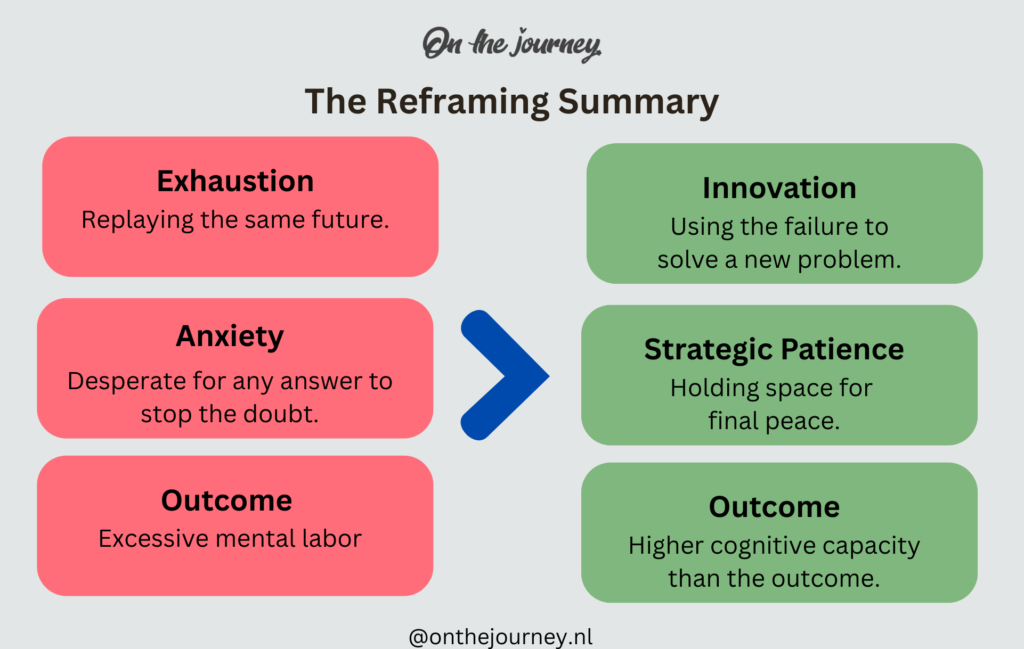
Overthinker’s Paradox is a primary trap which is the tendency to mistake mental exhaustion for actual progress. When you over-analyze, you risk constructing a ‘perfect’ solution tailored for a frictionless vacuum the universe of your brain which is a messy and unpredictable universe of reality. Without the ‘controlled friction’ of real-world experimentation, your cognitive energy forms a closed loop. It ends up feeding on its own assumptions. To succeed, you must stop polishing the theory and start building the bridge, using small, messy actions to tether your brilliance to the ground.
“For innovators, their productive pondering results in creative problem-solving and great success. However, ruminators… experience poor recovery from work and stuckness.” — Dr. Alice Boyes
Perfectionism is an Emotional Tolerance Problem
Perfectionism is more than a desire to do well; it’s a personality trait marked by the pursuit of flawlessness and exceptionally high performance standards. It often comes with overly critical self-evaluations and worries about others’ judgments. In reality, it is an emotional avoidance strategy. According to psychologist Nick Wignall, perfectionism isn’t about being perfect; it’s about feeling perfect.
When you overthink an email or a project, you are often using that mental activity to distract yourself from the visceral discomfort of being “less than.” If you can convince yourself there is still “more to think about,” you successfully delay the moment you must face your own perceived inadequacy. To break the cycle, you must shift your focus from the quality of the work to your emotional tolerance. The goal is learning to sit with the “imperfect” feeling without needing to “think” it away.
The Mental Safety Blanket of Helplessness
Our brains detect threats however they usually interpret it as intense worry or anger with a great bias. When such thoughts occur we instinctively reach for the Illusion of Control. When we feel helpless, our minds can’t stand it. So we start overthinking to make ourselves feel like we’re taking action. Thinking seems like doing something, even if it isn’t. It gives us a false sense of control in a world full of randomness. In a way, we use the ‘cool’ logic of overthinking to calm the ‘hot’ feeling of being helpless.
Uncovering the “Secondary Gains” of a Racing Mind
Habits persist because they meet a need. If your overthinking feels impossible to quit, it may be because you are receiving secondary gains that are obvious benefits that serve as social or personal currency.
The brain sometimes uses overthinking as a procrastination heuristic: if you haven’t “thought it through enough,” you cannot be blamed for making a wrong decision or taking a risk. For others, it becomes a way to garner sympathy or connection from those around them. It is an attempt for the brain to seek for safety. The path out requires radical honesty: What is this loop protecting you from? Often, the solution is replacing the loop with emotional vulnerability which is being assertive about your needs rather than hiding behind your “stress.”
Transform racing mind into productive action
To transform your racing mind, you must move from abstract simulation to concrete reality. This “upcycling” process relies on grounded experimentation:
Specific Gratitude: Replace vague abstractions (e.g., “I’m grateful for my life”) with narrow, present-moment observations (e.g., “I’m grateful my coffee was the perfect temperature this morning”). This anchors the mind in the now, preventing it from drifting into the “what if.”
The 24-Hour Rule: When a “hot thought” demands an impulsive response, write it down and wait 24 hours. This allows your internal alarm system to deactivate before you take action.
Fact-Checking the 1%: Always ask: “Is this thought 100% true?” Our insecurities create elaborate fictions that rarely align with the data. “99% of the harm is caused in your head, by you and your thoughts. 1% of the harm is caused by the the reality, what actually happens, and the outcome.”
Bring your mind to the ground
The goal of cognitive wellness is not to stop thinking; it is to ensure your thinking leads to a result. Your mind is a high-performance engine. If it is currently redlining in neutral, the solution is to engage the gears through real-world experimentation.
Acceptance is not resignation; it is the realization that no amount of anxiety can change the past, and no amount of simulation can perfectly guarantee the future. Peace is found when you stop trying to solve the “universe of your mind” and start participating in the one you actually inhabit.
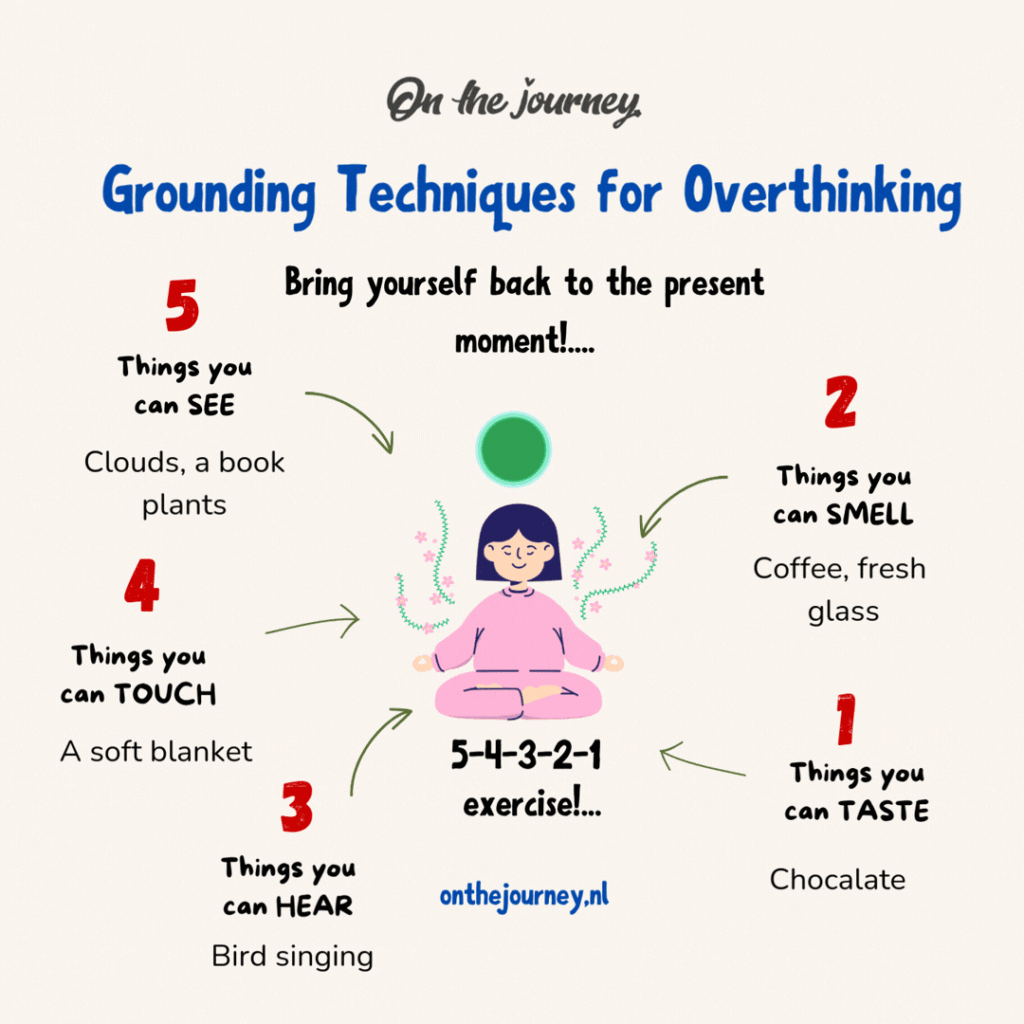
A practical strategy to interrupt the cycle of overthinking is grounding technique, to bring the attention back to the present moment. When someone becomes overwhelmed by racing thoughts, grounding helps anchor the mind in reality using the senses, physical movement, or focused breathing. A common method is the 5-4-3-2-1 technique, which involves identifying things you can see, touch, hear, smell, and taste. Other grounding practices include deep diaphragmatic breathing, feeling your feet on the floor, or holding a textured object to redirect mental energy.
Overthinking techniques work by calming the nervous system, reducing anxiety, and creating a mental pause that allows clearer, more balanced thinking. Regular use of grounding can make it easier to manage intrusive thoughts and break the pattern of overthinking.
Conclusion
Thoughts can be transformed into something positive and productive when managed usefully.
A racing mind should be viewed as a high-performance engine rather than a malfunctioning machine. With proper direction, it can transition from feeling ‘broken’ to becoming productively engaged. A technique that can interrupt overthinking is using grounding to anchor yourself. It helps you quickly check how true your memories feel and how aligned they are with reality.
Train your mind to stop ruminating for a perfect feature and start participating to the present. True peace doesn’t come from trying to reason your way out of a mental loop. It comes from grounding your strengths and letting your inner engine carry you forward.