

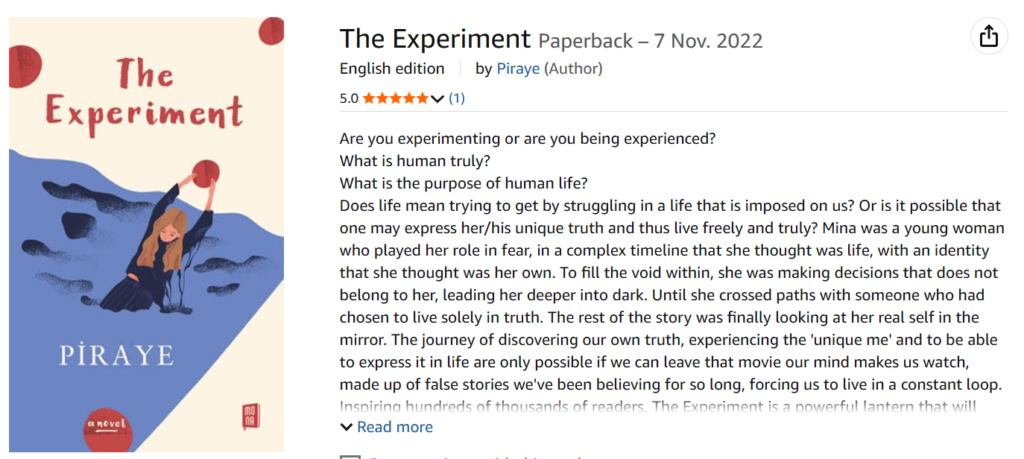
The novel Seyir (The Experiment) opens with a haunting confrontation in a mirror. “Do you recognize the person staring back,” the narrative asks, “or are you confronting a stranger curated for public consumption?” In Piraye’s Seyir, we meet Mina (the main character) on her wedding day a moment traditionally synonymous with joy and self-actualization. Yet, instead of a glowing bride, she is met by “dead fish eyes”: dull, frozen, and vacant. It is a terrifying state of internal dissociation, leaving her profoundly numb even as she steps toward a new life.
On what should have been the most joyous morning of my life, I stood before a floor-length mirror. I was the very picture of success, yet I felt trapped draped in expensive fabrics that formed a luxurious cage. I was about to marry Celal, a man who radiated power and stability, but when I met my own gaze, I didn’t see a bride. I saw a dead fish: eyes vacant, dull, and frozen. While my body played the part of the radiant fiancée, my soul lurked in the shadows, writhing in silent agony. I had become a mere guest in my own existence.
From “Watching” to “Being”: The Essence of Seyir
To “wake up” from this dream, one must move from being a passive spectator to an active observer. An observer sees reality without the fog of self-deception and chooses to step onto the path. This is the transition from seyretmek (watching) to seyir (the voyage) the moment we stop performing and start living. The novel explains that our minds are filled with persistent thoughts that dictate our lives through “shoulds,” forcing us into action.
A core message of Seyir is that these thoughts resemble masks that we have unconsciously acquired and feel obliged to wear. Mina’s experience is a visceral case study in “dissociative armor” the psychological distance we create to survive toxic environments. When we spend our lives performing for an audience, we don’t just lose our relationships; we lose the somatic connection to our own existence.
The Incompleteness Trap
At the core of Mina’s psyche is a chronic sense of incompleteness. More than just a metaphor for sadness, it is an existential deficiency rooted in childhood. She views herself as fundamentally ‘defective,’ as if there were a physical hole in the center of her heart.
At the core of Mina’s psyche is a chronic sense of incompleteness. More than just a metaphor for sadness, it is an existential deficiency rooted in childhood. She views herself as fundamentally ‘defective,’ as if there were a physical hole in the center of her heart.
I was incomplete. Something was missing in me, but what? Whatever was missing had created a hole right in the center of my heart.
People Pleasing in a Pathological Level For Self-Defence
Mina’s survival strategy is the performance of the ‘Perfect Woman.’ To cultivate a sense of value, she adopts a policy of total compliance, transforming herself into a mirror for the desires of the men in her life. She dons a mask and psychological armor before stepping onto the ‘stage’ of her relationships a detachment so extreme that she even tolerates ‘border pillows,’ physical barriers placed in the marital bed to ensure she never accidentally touches her partner, Celal, in her sleep.

Be what they want, be that! … I would be whatever you wanted me to be.
The most devastating consequence of performance is the divorce of the body from the self. It is a form of sacrification to please others. Since age twenty, following a traumatic encounter with her first partner, Utku, Mina has lived under a “sentence” of defectiveness. Fearing abandonment, she began the lifelong “theatre” of faking intimacy.
Her performance is a form of erotic labor. She fakes pleasure to avoid being ‘sent to a doctor’ a threat once leveled at her that reinforced her identity as ‘broken.’ This is somatic betrayal: performing the signs of life while the soul is in agony. It is the tragedy of sustaining a partner’s ego at the cost of one’s own physical integrity. She denies her self, her feelings, and her biology for the sake of pleasing her partner.
The “Obligation” Trap
The novel suggests that obligation is an illusion; what truly exists is the fear of the upheaval that accompanies choice. To shift from victim to agent, one must be willing to endure the tremor that comes with taking responsibility.
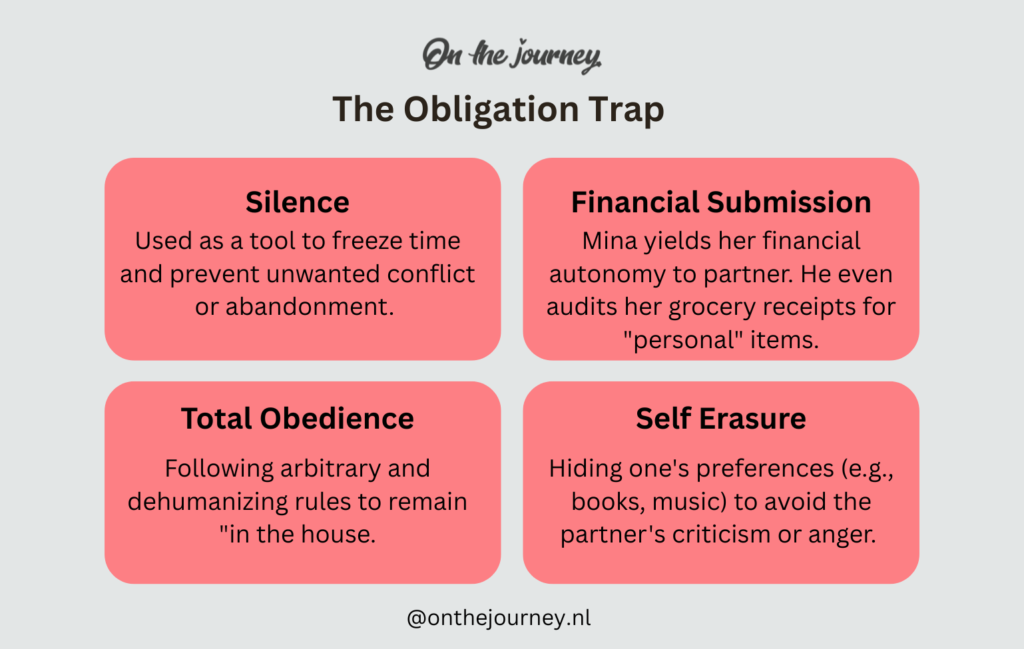
Mina often feels compelled to behave in certain ways. She believes she is “obligated” to endure Celal’s cruelty, “obligated” to maintain her mask, and “obligated” to remain in the life she knows. This language becomes a psychological shield—one that allows her to see herself as a victim of circumstance rather than the architect of her own fate.
The message given in the book is “There is no such thing as obligation… Man is a being who can choose.”
The Core Message of “Seyir”
This novel Seyir is a great self development material. The core message is to free oneself from imposed beliefs and reconnect with one’s authentic self. You can order a copy from Amazon.
Piraye’s narrative compels us to face a harsh truth: the void within cannot be filled by a more convincing performance or a more seamless mask. Authenticity is the only antidote to the conviction of being ‘defective.’ So long as you are preoccupied with the upkeep of the stage, you can never truly be the voyager on your own path.
The ultimate diagnostic question that you need to ask yourself is “Are you the voyager, or merely the spectator of this realm?” (“Seyir eden misin, seyreden mi bu âlemde?”)
1 comentario