The modern world is full of demands. A persistent sense of being “not enough” has become a nearly universal part of the human experience. We live in a world of highlight reels and filtered images, making many people feel as though they must be perfect to fit in or succeed. However, as a psychologist, I see the toll this takes: a generation of high achievers who are perpetually exhausted and emotionally fragile. From the outside, it might look perfect; however, on the inside, it is filled only with empty, desperate feelings.
Psychological research reveals that perfectionism is far more than a simple desire to do well; it is what we call a multidimensional personality disposition. It reflects a complex interplay between the pursuit of exceptionally high standards and a harsh, self-critical style of evaluation. Striving for perfection not only leaves us tired and exhausted, but the constant internal criticism can also become deeply frustrating and, over time, negatively affect our mental health.
Perfectionism is a toxic trap constructed by our own ambition. The persistent lack of internal approval keeps us locked in a cycle of pressure and self-doubt. Learning to break free from that cage and to embrace progress over perfection is essential for living a healthy, balanced, and fulfilling life.
Perfectionism has two distinct sides
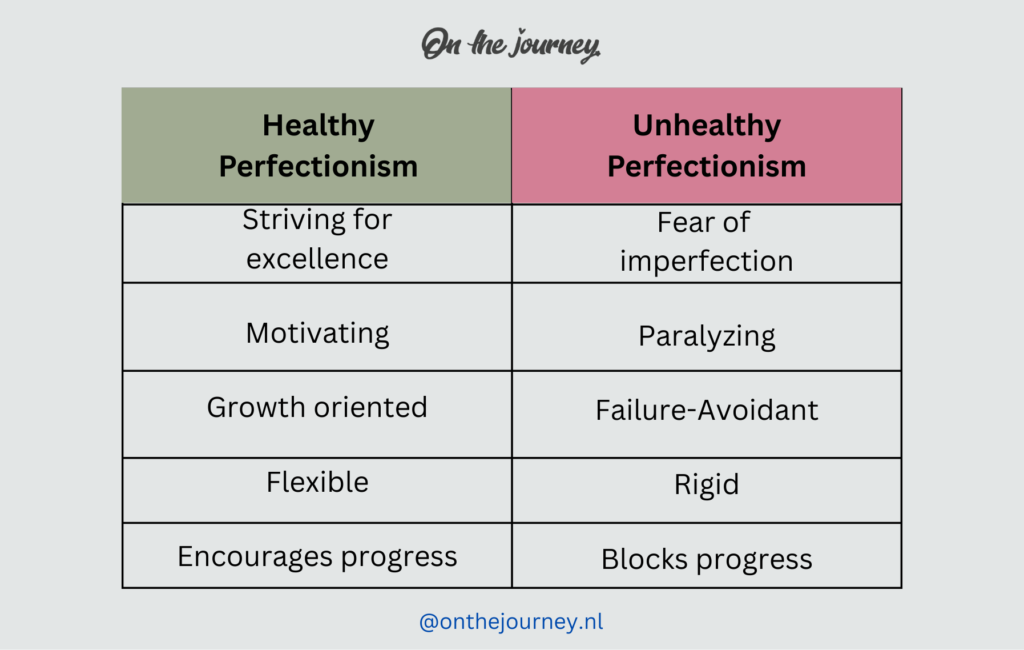
Perfectionism has two sides: one positive and one negative. On the positive side, it can motivate people to strive and improve; however, on the negative side, it can become a toxic trap that leads to stress and overwhelm. Joachim Stoeber is a dedicated researcher whose work has significantly advanced our understanding of perfectionism. He has conducted influential studies on the two-factor theory, demonstrating through thorough factor analyses that there are two higher-order dimensions that shape our mental well-being.
Benefits of healthy perfectionism:
- High personal standarts
- Increased resilience
- Satisfaction from progress
Unhealthy Perfectionism: This is the maladaptive side, characterized by a strong fear of mistakes and negative evaluation. Individuals often experience intense fear of failure and engage in harsh self-criticism. It is frequently accompanied by procrastination, as the person delays tasks until they believe they can perform at an optimal or “perfect” level.
Internal and External Expectations of Perfectionism
There are multiple drives for perfectionism that have internal and external causes.
Internal perfectionism arises from the high standards we impose on ourselves. Its defining characteristics include self-imposed rules and lofty expectations, creating intense internal pressure, where achievement becomes closely tied to self-worth. Individuals with internal perfectionism often hold themselves to higher standards than others.
A core belief underlying internal perfectionism might be: “I must produce excellent work to impress others.” This belief can stem from early experiences of feeling unseen or unacknowledged by parents, leading to a persistent desire to satisfy unmet needs through approval from authority figures, such as teachers.
Perfectionism is often fueled by external pressures. Many people feel a constant drive to outperform others simply to gain validation. This is frequently rooted in a fear of criticism, a dread of “mediocrity,” or a sense of self-worth that is entirely tied to achievement. Factors like performance anxiety and the “spotlight effect” only intensify this pressure.
A lack of boundaries is another significant culprit. Without clear limits, it is easy to overcommit to work for the reason of pressure to perform, but also the concept of “enough” hasn’t been defined. To overcome the toxic side effects of perfectionism, it is essential to establish a healthy sense of self-limitation.
When these two dimensions collide, the result is often a state of “chronic dissatisfaction.” While the drive to improve is a natural human instinct, it turns toxic the moment it is fueled by evaluative anxiety rather than a genuine love for the craft.
“The striving for perfection is innate in the sense that it is a part of life, a striving, an urge, a something without which life would be unthinkable.” – Alfred Adler
Becoming a victim of “should”
The origins of perfectionism often trace back to what psychoanalyst Karen Horney famously termed the “tyranny of the should.” This neurotic disposition emerges as we internalize rigid expectations from authority figures and society, transforming them into a relentless internal monologue. This internalization is rarely a direct mirror of reality; rather, external demands are often distorted and often filtered through our own internal processing mechanisms.
Under this “tyranny,” the psyche adopts a restrictive all-or-nothing cognitive pattern. Genuine curiosity is sacrificed for an inflexible framework of who we believe we ought to be. This mental rigidity stifles the authentic self, replacing the process-oriented joy of existence with an obsessive over-expenditure of energy toward results that never satisfy. Ultimately, when ruled by these “shoulds,” we lose the capacity to recognize our own fundamental needs.
More often than not, these rigid and maladaptive mechanisms create internal “hells.” The thoughts they produce drive us toward a life of chronic unpleasantness. We find ourselves trapped in behaviors that are fundamentally incongruent with our core values and true moods, creating a painful rift between who we are and how we act.
Toxic ideals that came with industrial era
The Industrial Era, beginning in the early 1900s, fundamentally reshaped our standards for everything from labor and progress to family life and physical appearance. For over a century, generations have been raised under the weight of rigid, often toxic, expectations regarding how men, women, and children “should” look, act, and even eat. While not all societal standards are inherently harmful, the danger lies in the “one-size-fits-all” approach of a consumer society that ignores our unique individual needs. These ideals become toxic the moment we believe we must conform to them to be valid.

Today, global marketing acts as a “toxic idealization machine.” Brands systematically tap into innate human fantasies to sell a singular, narrow story. We see the “fit” mother with the perfectly dressed child, the toothpaste ad featuring impossibly white teeth, and the anti-aging cream promoted by a face with no wrinkles. These are not just advertisements; they are false life standards that create a perpetual gap between reality and the “ideal.”
Every day, we are bombarded with images of “perfect,” happy, and problem-free figures draped in luxury brands. This creates a deeply distorted impression of human life. Wherever there are people, there are complex interactions and daily struggles. Even the human body itself is far from perfect; each of us is unique, with our own specific needs and challenges. We are diverse, short, tall, blond, dark-haired, bald, or living with disabilities. Our bodies naturally come in every shape and size. There is no “one-size-fits-all” solution for the human experience, and the key to true happiness is never as simple as a purchase.
Conclusion
Perfectionism is a multidimensional personality trait defined by a complex interplay between the pursuit of exceptionally high standards and the application of a harsh evaluative lens. Grounded in the two-factor theory researched by Joachim Stoeber, this trait manifests in two distinct dimensions: perfectionistic strivings (adaptive) and perfectionistic concerns (maladaptive).

Healthy perfectionism is characterized by an intrinsic drive for excellence, resilience, and cognitive flexibility, allowing individuals to derive genuine satisfaction from their progress. Conversely, unhealthy perfectionism is fueled by a chronic fear of failure and external evaluation. This often results in rigid cognitive patterns, paralyzing procrastination, and a persistent deficit of internal approval.
The roots of this disposition often stem from the “tyranny of the should,” a state where we internalize rigid expectations from parents, teachers, and society, replacing genuine growth with an inflexible framework of who we believe we ought to be. This internal pressure is further exacerbated by the global “marketing machine,” which projects artificial life standards and “perfect” images designed to exploit innate human fantasies.
By ignoring our inherent uniqueness and the reality of life’s daily complexities, these toxic standards leave many in a state of perpetual exhaustion and emotional fragility. To break free, we must prioritize progress over perfection, define a personal concept of “enough,” and reclaim the authentic self through the practice of self-acceptance.